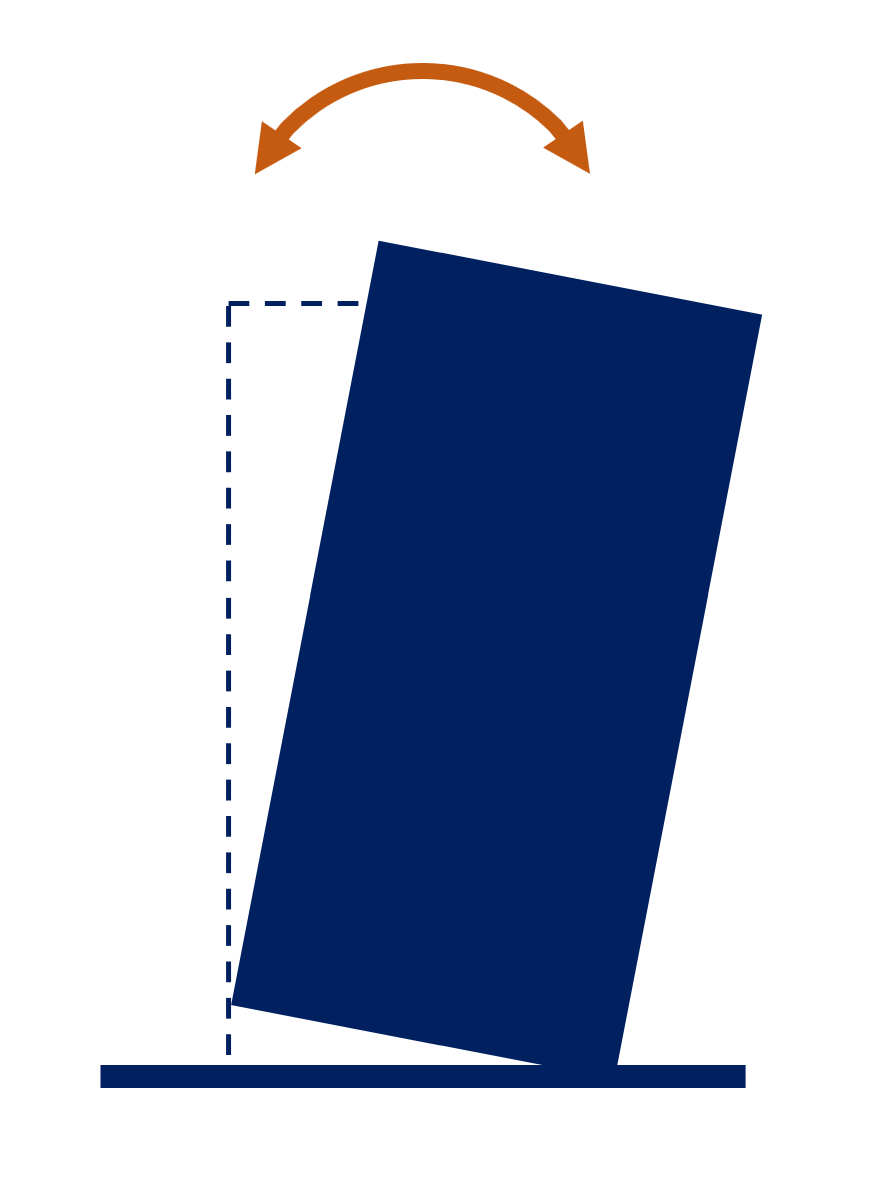
Free Rocking
Analyses a structure that rocks freely on its base, held in place only by its own weight. Use it to see how a free-standing rocking structure responds to an earthquake record and to get its nonlinear response.
Launch Free Rocking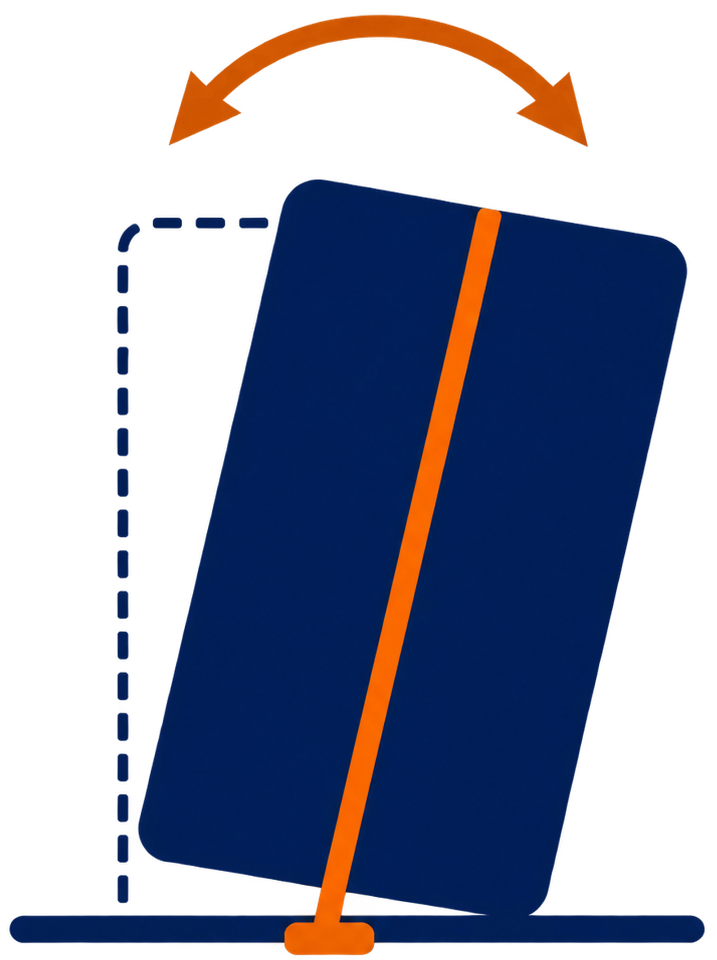

A simulation platform
An interactive collection of tools for understanding the rotational response of rigid blocks, from free rocking to tendon-restrained systems.
RockSuite is a freely available web-based program that simulates the rotational response of rigid blocks
rocking under earthquake ground motion. It offers two options. The free rocking rigid block captures the
natural oscillatory motion of an unrestrained block rocking on its base. The tendon-restrained rocking rigid
block adds vertical post-tensioned tendons that limit the rocking amplitude and help return the block to its
upright position. RockSuite gives engineers and researchers a versatile platform to study the dynamic
behaviour of rigid structures, and to see how parameters such as block geometry, number of tendons, initial
prestress force and ground motion intensity affect the response.
Rocking isolation is a seismic protection method in which a structure is allowed to uplift and rock on its
base, instead of being rigidly fixed to its foundation. Rocking limits the forces that pass into the
structure, which allows a lighter and more efficient design while keeping it safe against overturning. The
method suits slender structures where base forces and overturning govern the design. These include buildings
such as fully modular steel high-rise buildings, high-voltage transmission line structures such as towers and
poles, and other tall, slender structures.
You enter the block’s geometry, the tendon arrangement and prestress force where relevant, and an earthquake
record, which can be your own acceleration time history or the built-in sample accelerogram. RockSuite then
runs a nonlinear time-history analysis, tracking how the block uplifts, rocks and resettles throughout the
shaking. It gives the rotation time history and peak rotational response of the block, from which the
nonlinear behaviour of the structure can be understood and the design forces calculated using methods
published through peer-reviewed research. Results are shown in interactive plots and can be exported to Excel
for further analysis and reporting.
Two complementary models to investigate the rotational response of rigid blocks under external excitation.
Analyses a structure that rocks freely on its base, held in place only by its own weight. Use it to see how a free-standing rocking structure responds to an earthquake record and to get its nonlinear response.
Launch Free Rocking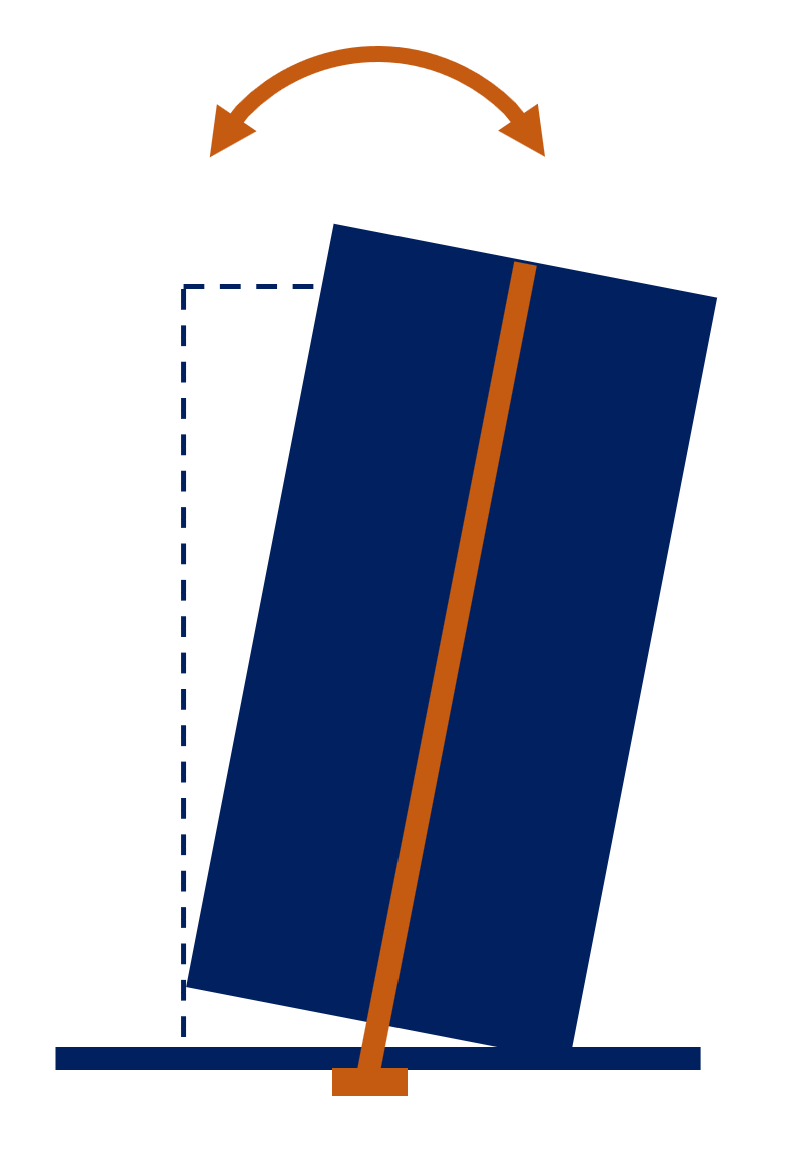
Analyses a rocking structure restrained by vertical post-tensioned tendons anchored into the foundation. The tendons add stability against overturning and pull the structure back to its upright position after shaking. Use it to assess the nonlinear response of tendon-restrained structures.
Launch Tendon-Restrained RockingRockSuite tells you how a rocking structure responds to an earthquake. Turning that response into a safe and efficient design needs further guidance. How should a building or structure be proportioned so that it can rock without overturning? How many tendons are needed, and how much prestress force should they carry? How are the design forces for the structure, its connections and its foundation worked out from the rocking response? These questions have been addressed through research at The University of Melbourne on rocking isolation with tendon restraint for fully modular steel high-rise buildings. The research has developed step-by-step design procedures for structures that are allowed to rock under wind and earthquake actions. To learn how to design buildings and structures with rocking isolation, and how to use the results from RockSuite in your design, visit the published work.
Investigates how tendon-restrained rocking isolation reduces seismic demands in modular steel buildings, resulting in savings in structural steel and connection hardware. The study also identifies the building heights where rocking isolation is most effective.
Download ArticleDevelops a simplified linearisation approach for obtaining seismic design forces in tendon-restrained rocking-isolated buildings. The proposed response modification factor enables the use of familiar code-based design methods.
Presents an integrated design approach for modular rocking-isolated buildings, addressing tendon placement, anchorage detailing and staged prestressing during construction, without compromising building functionality.
The researcher and developer behind RockSuite.

Researcher / Structural Engineer
Deelaka Jayaweerarathne completed his doctoral research in Structural Engineering at The University of Melbourne. He obtained his BSc Eng (Civil Engineering) degree with First Class Honours from the University of Peradeniya, Sri Lanka. Deelaka began his career as a structural engineer on major infrastructure and building projects in Sri Lanka, including the New Kelani Bridge Project and the Waterfront Integrated Resort Project, where he gained practical experience in the analysis, design and construction of large-scale structures. His research and professional interests are in earthquake engineering, seismic isolation, rocking structures, post-tensioned structural systems, modular construction and nonlinear structural dynamics. His work has been published in international journals and presented at national engineering conferences. Deelaka developed RockSuite to bring advanced seismic design concepts into practical, easy-to-use and freely available tools for structural engineers and researchers. He is a Graduate Member of Engineers Australia (GradIEAust).
Questions about the simulation programs, publications or research collaboration? Use the form to prepare an email.